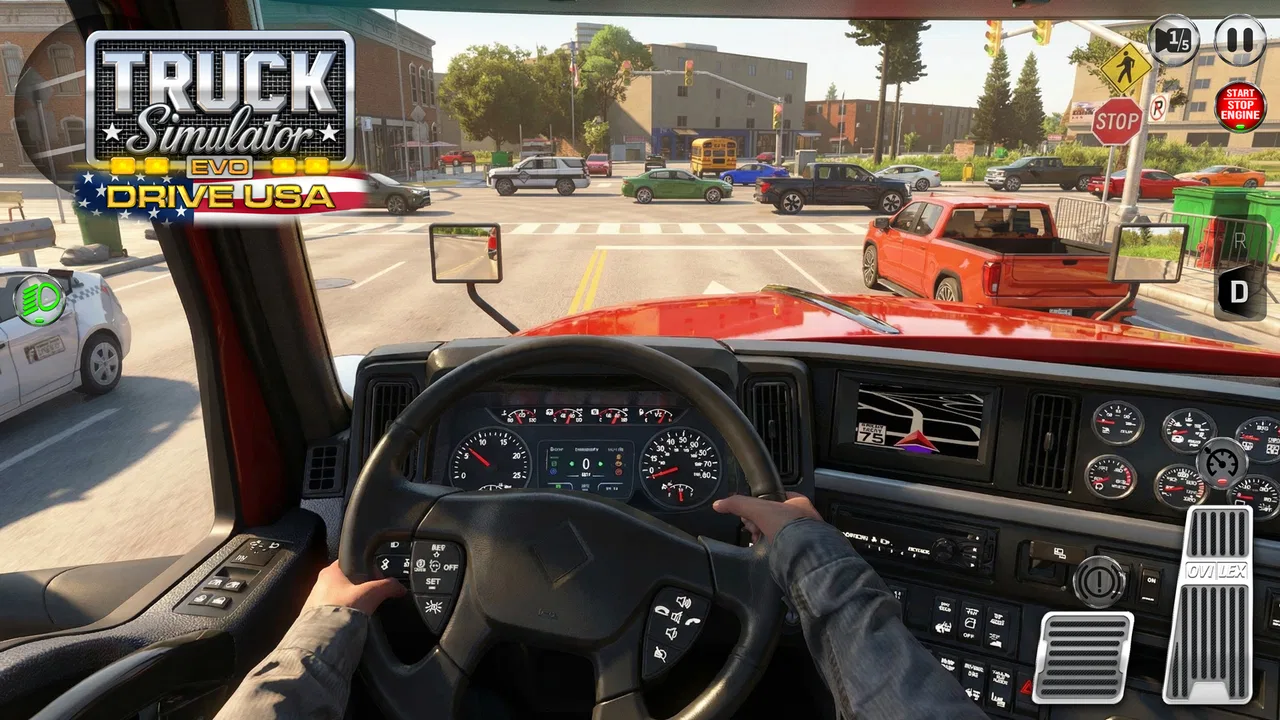
Truck Simulator EVO: Drive USA
- 4.6
- Rating
- 5.00M
- Installs
- Free
- Price

 Analysis by App-foxy
Truck driving games often make a strong first impression: a large vehicle, a long road, and the promise of turning a quiet journey into a satisfying routine. Truck Simulator EVO: Drive USA takes that familiar idea and places it in a simulation setting built around American trucks, cargo work, cities, and highways. I found the appeal easy to understand during the first sessions, but the more important question is whether the experience has enough depth to remain part of your regular gaming rotation after the novelty wears off.
Developed by Ovidiu Pop, this is a free simulation game for players who enjoy careful driving more than constant action. It is rated for Everyone, works on Android devices running version 8.0 or later, and its current version is 1.2.55. The game has already passed one million installs and holds a 4.6 average from around 62 thousand ratings, which suggests that its basic formula connects with a wide audience. I would still look beyond those figures, because a truck simulator can be enjoyable for one kind of player and surprisingly tiring for another.
What the first week feels like
By the end of the first week, I’d pay attention to which parts of a trip I actually look forward to: threading through city streets, settling into a highway stretch, or simply finishing a delivery cleanly. That distinction helps separate a passing interest in big trucks from a genuine liking for the game’s steady routine. It also gives the next stage a clearer test: whether the familiar drive still feels rewarding once the controls and setting are no longer new.
You May Also Like

 Blood Strike: 2.5 Anniversary
Blood Strike’s Loadouts Turn Every Drop Into a Tactical Gamble
A close look at Blood Strike’s custom loadouts: how fast access to signature weapons reshapes its battle royale rhythm, rewards preparation, and narrows the gap between fights.

 Pandora - Music & Podcasts
Pandora’s Music Is Easy to Start, but Harder to Recover
Pandora’s strength is its low-effort path from a seed to a station. Its weak spot is how much confidence it asks you to place in connection, setup, and quiet recovery.

 8 Ball Pool
 Is Built on Rivalries, Rematches, and Routine
A close look at the rivalries, rematches, shared routines, and unanswered safety questions that turn a quick pool match into a persistent mobile community.

 Samsung Music
’s Quiet Strength Is Playing What You Already Own
Its reach comes less from spectacle than from dependable access to a personal library. That simplicity is both the app’s strongest retention engine and its ceiling.

 AccuWeather: Weather Radar
AccuWeather Review: A Quick, Clear Forecast for Everyday Decisions
For everyday plans, the best forecast is the one you can understand quickly. AccuWeather makes rain timing, radar, and local conditions easy to act on, with a few trade-offs.

 Hill Climb Racing
Why Hill Climb Racing Still Turns Crashes Into One More Run
A tiny car, a bumpy hill and one more upgrade: Hill Climb Racing keeps resurfacing because its simple chaos makes every near-miss feel personal.
More From Our News Desk



A relaxed start with a clear driving fantasy
My first impression was that the game understands why people download a truck simulator in the first place. The attraction is not simply reaching a destination. It is the feeling of managing a large vehicle through ordinary traffic, keeping a delivery moving, and treating a route as a small task that deserves attention. The American setting gives that routine a recognizable identity, with urban roads and long highway stretches creating a useful contrast.
That contrast matters on mobile. City driving asks for more patience because turns, positioning, and traffic require closer attention. Highways feel more open, but they can also expose whether you genuinely enjoy steady progress. I liked switching mentally between those two moods. A short session can feel like a practical errand, while a longer one gives the game room to settle into a road-trip rhythm.
The game is best approached as a simulation rather than an arcade racer. If you expect immediate speed, dramatic collisions, or a constant stream of rewards, the pace may seem restrained. I found that restraint more appealing when I played with the goal of completing a clean delivery instead of chasing excitement every few seconds. That change in mindset is important: the game becomes more enjoyable when careful driving is treated as the main activity, not as an obstacle between flashy moments.
Why the opening sessions are convincing
The first week benefits from a simple loop that is easy to understand. You take on cargo transport work, drive through the American road environment, and learn how much attention a large truck demands. Even without turning every session into a serious simulation exercise, the basic routine gives you a reason to return. I could play for a short period, finish a route, and stop without feeling that I had abandoned a complicated storyline.
That makes it a particularly good fit for someone who wants a game with a practical rhythm. It can accompany a quiet evening, a commute break, or a few minutes when you want something more involved than a puzzle but less demanding than a competitive match. A realistic everyday use case would be playing one delivery after dinner: I can focus on traffic and road position, complete the job, and put the phone down without needing to coordinate with other players or remember a large plot.
The American truck theme also gives the game more character than a generic driving sandbox. The vehicle is not just a small car moving around a track. Its size changes how I think about corners, lane placement, and momentum. That difference creates the first meaningful layer of simulation, even for players who are not experts in trucking.
Controls decide whether the novelty survives
Truck games live or die by how comfortable they feel in the hands. A route can be beautifully designed, but awkward steering will make every delivery feel like work. I recommend spending the first sessions learning the control response instead of immediately trying to drive quickly. Smooth inputs are more useful than sudden corrections, especially when the truck occupies more space than a normal road vehicle.
There is also a practical trade-off between realism and convenience. A more demanding control style can make successful driving feel earned, but it increases the effort required for casual play. I would not judge the game after a rushed first attempt. Give yourself a few routes to decide whether the handling becomes natural. If you still feel that every turn is a wrestling match, the game may not be a good long-term fit, no matter how attractive the setting looks.
One useful habit is to treat lane changes as planned actions rather than reactions. I found that looking ahead and preparing early reduced the number of frantic steering corrections. That sounds obvious, but it changes the whole experience: the truck feels more predictable, and the road becomes something to read instead of something to survive.
What kind of player will enjoy the opening most?
This is a strong starting point for players who like mobile driving simulation, American road scenery, cargo routines, and games that reward patience. It also suits people who enjoy learning a control system gradually. The first-week appeal is less convincing for anyone who needs constant variety, rapid unlocks, or direct competition. Those players may prefer an arcade racer or a game built around short, high-intensity challenges.
I also would not choose it for a child simply because the age rating is Everyone. The rating makes the game broadly accessible, but a young player who wants immediate action may become bored with the measured pace. The right question is not only whether the game is suitable; it is whether the player actually likes the workmanlike rhythm of driving cargo from one place to another.
What remains after the first month
After a month, I’d judge the game less by how often I open it and more by whether it still fits the mood I want from a short session. Keeping a personal target—such as making smoother turns or avoiding rushed corrections—can give repeat routes a small purpose without pretending the game has become a different experience. The longer-term question is whether that self-directed challenge stays refreshing or starts to feel like an obligation.
Routine is the real source of lasting value
After the initial excitement of trying a large American truck fades, the game has to earn its place through habit. In my view, its lasting value comes from turning ordinary driving into a repeatable ritual. The satisfaction is modest but genuine: start a job, settle into the road, handle the difficult parts, and finish with a sense that the delivery was managed rather than merely completed.
That kind of value is different from progression systems designed to keep you chasing the next reward. Here, the recurring appeal depends heavily on whether you enjoy the act of driving itself. If you do, the game can become a dependable background activity. If you do not, no amount of new routes or trucks will fully solve the problem, because the central task remains cargo transport.
I think this is where the game separates itself from the usual alternatives in the driving category. An arcade racer is better when I want speed, instant feedback, and short bursts of excitement. A competitive multiplayer title is better when I want unpredictable opponents and social pressure. A broad open-world driving game may offer more freedom and spectacle. This game is better when I want the road to be the content and the delivery to provide structure.
How to keep monthly sessions from feeling repetitive
The most effective way to extend its life is to vary your own purpose. On one day, I might concentrate on completing a route without careless corrections. On another, I might use a short session simply to relax and enjoy the highway portion. Treating every delivery as a race makes the slower sections feel empty; treating each trip as a small driving exercise gives them more meaning.
A second useful approach is to separate learning sessions from relaxed sessions. When I am learning a difficult turn or adjusting to a truck’s behavior, I accept mistakes and focus on technique. When I want entertainment, I avoid overanalyzing every movement and let the journey provide the calm. Mixing those two moods deliberately prevents the game from becoming either an exam or a screensaver.
There is also a subtle benefit in using the game as a short-session title rather than insisting on long marathons. A cargo simulator can lose its charm when played beyond your attention span. One completed trip may feel satisfying; several similar trips in a row can make the same mechanics feel repetitive. I would rather return regularly for manageable sessions than force a long play period and blame the game for the resulting fatigue.
Who should skip it after the honeymoon?
Players who need a strong sense of constant advancement should think carefully before committing. The game’s appeal is tied to repeated driving, so the long-term experience may feel narrow if you are looking for a deep management game, a story campaign, or a large collection of unrelated activities. It is also not the best choice for someone who wants every session to produce a dramatic moment.
Another group that may lose interest is anyone who dislikes repetition in principle. Even a well-made route becomes familiar when the main activity remains driving cargo through cities and highways. I can forgive repetition when the handling and atmosphere are enough to carry it, but that is a personal threshold. If you usually abandon simulation games once the controls become familiar, this one may have a short shelf life for you.
Free entry, but plan around optional spending
The game is free to download, which makes it easy to test the core experience before deciding whether it belongs on your phone. It includes in-app purchases ranging from $0.99 to $44.99 per item. I would approach those purchases as optional convenience or support rather than as a reason to start playing. The important test is whether the unpaid driving loop already feels worthwhile.
My practical advice is to play enough to discover whether you enjoy the roads, the truck handling, and the delivery rhythm before spending anything. A purchase cannot make an unsuitable genre suddenly become enjoyable. Conversely, if the basic loop already fits your taste, you can make a more informed decision about whether optional items are worth the cost to you. This is especially relevant for a game intended to occupy a long-term place in your routine, because small impulses can become less satisfying when they are made before you know how often you will actually return.
Maintenance, fatigue, and the long-term verdict
For me, the best way to protect the game’s appeal is to stop while a delivery still feels satisfying, rather than extending a session until the familiar routine becomes tiring. I’d also treat control comfort as a practical threshold: when I’m distracted or impatient, another game is likely a better choice for that moment. With those limits in mind, the verdict comes down to whether a measured cargo-driving ritual is something I genuinely want to return to.
The maintenance burden is mostly your attention
When I think about maintaining a game like this in my regular rotation, I do not mean complicated account management. The larger burden is mental. You need to remain patient with the pace, keep your inputs controlled, and accept that a successful session may look quiet from the outside. That is a pleasant form of maintenance for some players, but it is still a requirement.
There is a useful distinction between difficulty and friction. Difficulty can make a clean delivery satisfying. Friction is the feeling that the game is asking for effort without giving you an equally satisfying response. In this title, the balance depends on your control comfort and tolerance for repetition. If the truck’s movement feels understandable, careful driving becomes the challenge. If it feels awkward, the same task becomes an irritation.
Phone conditions matter too. I would choose a stable grip and avoid playing when I am distracted, because divided attention makes a slow simulator feel much more demanding. This is not a game I would recommend for someone who wants to play while constantly switching between messages and other tasks. The best sessions happen when I can give the road enough attention to anticipate turns and traffic rather than reacting at the last moment.
Where fatigue starts to appear
The main source of fatigue is repetition, not complexity. Cities and highways provide different driving contexts, but both ultimately serve the same cargo-delivery purpose. Once the first-week discovery is gone, you may notice that the emotional reward of a completed trip is quieter. That is not necessarily a flaw, but it means the game should be judged as a steady hobby rather than an endless source of surprises.
Long sessions can also expose the limits of the formula. The first route may feel immersive, while the third or fourth can feel like an obligation if you are playing only to reach an arbitrary stopping point. I recommend ending a session after a satisfying delivery instead of continuing until the game feels dull. Preserving a little appetite for the next trip is one of the simplest ways to protect its long-term value.
For some players, fatigue will come from the opposite direction: the game may not provide enough pressure. If you want aggressive traffic, close competition, or constant danger, the calm road-work structure may feel underpowered. In that situation, an arcade driving game is the better alternative, not because this simulator fails at its goal, but because your goal is different.
Small techniques that improve repeat play
I found three habits especially useful. First, I plan turns earlier than I would in a normal car game, which reduces overcorrection and makes the truck feel easier to control. Second, I use short sessions when I want relaxation and reserve longer routes for times when I can concentrate. Third, I judge a play session by driving quality rather than only by speed. A calm, clean delivery is a better personal target than rushing and turning the game into a stressful contest.
These habits are not hidden buttons or special unlocks; they are ways of working with the game’s central design. That is precisely why they matter for long-term use. The title does not need to become a different kind of game every month if you enjoy refining your own approach. The recurring value comes from making the same basic activity feel smoother, more deliberate, and more relaxing.
My final recommendation
Truck Simulator EVO: Drive USA earns lasting space on my device if I want a calm, repeatable driving simulator rather than a high-energy racing game. Its first-week appeal is clear: American trucks, cargo jobs, city streets, and highways create an approachable fantasy that is easy to understand. Its month-to-month value is more personal. Players who enjoy routine, controlled movement, and gradual improvement can keep finding satisfaction in it, while players who need constant novelty will probably move on.
I appreciate that the free entry lets you test that distinction for yourself. The Everyone rating broadens its audience, and the Android 8.0 requirement makes it accessible to many compatible devices. At the same time, the in-app purchase range means I would stay deliberate about spending until the core loop has proved that it belongs in my routine.
My honest verdict is that this is not a universal driving recommendation, and it should not try to be. It is a focused simulation for people who like the quiet responsibility of moving cargo across an American road network. I would recommend it to a friend who enjoys truck games, wants a noncompetitive way to unwind, or likes turning small improvements in control into a satisfying habit. I would point that friend elsewhere if they wanted speed, spectacle, deep management, or a constantly changing challenge. For the right player, the novelty fades into something better: a dependable road-going ritual with enough structure to make returning feel worthwhile.
FAQs for Truck Simulator EVO: Drive USA
01What is Truck Simulator EVO: Drive USA?
Truck Simulator EVO: Drive USA is a driving and simulation game focused on operating heavy trucks across American-style roads and environments. Players can take on transport jobs, travel between locations, manage their vehicle, and work toward building a more successful trucking career. It is designed for users who enjoy realistic driving controls, long-distance routes, vehicle customization, and a slower, more methodical gameplay experience than arcade racing games.
02Can I play Truck Simulator EVO: Drive USA offline?
The game may allow some driving and career features to be used without a constant internet connection, but availability can depend on the version installed, device, and specific game systems. Online connectivity may still be required for advertisements, updates, cloud-related functions, or certain downloadable content. Before starting a long trip offline, it is recommended to launch the game while connected and verify which menus and jobs remain accessible.
03Does Truck Simulator EVO: Drive USA offer realistic truck controls?
Yes, the game is built around simulation-style truck driving rather than simple tap-to-win racing. Depending on your preferred setup, you can usually interact with steering, acceleration, braking, camera views, and other driving controls while managing the greater size and slower response of a truck. New players should expect a learning curve, especially when reversing, turning in tight areas, parking, and maintaining control at higher speeds.
04Can I customize or upgrade trucks in the game?
Truck Simulator EVO: Drive USA generally includes progression features that let players improve their trucking experience through vehicle selection, upgrades, or visual customization, although the exact options can vary by platform and game version. Progress is commonly connected to completing deliveries and earning in-game currency. Some items may require significant playtime, while optional purchases or advertisements could provide additional progression opportunities.
05Is Truck Simulator EVO: Drive USA suitable for low-end phones and tablets?
The game can be demanding because it uses 3D environments, detailed vehicles, traffic, and large driving areas. Performance will depend on your device’s processor, graphics hardware, available memory, operating system, and storage space. On older or entry-level devices, you may experience longer loading times, reduced frame rates, or graphical limitations. Checking the store requirements and keeping free storage available is advisable before downloading.
Pros
- Large USA map with varied routes and scenery
- Many trucks and customization options to unlock
- Realistic driving physics and vehicle handling
- Works well for short or extended play sessions
- Regular updates add improvements and new content
Cons
- Some trucks and features require in-app purchases
- Traffic behavior can occasionally feel predictable
- Long journeys may become repetitive over time
- Large maps can lead to extended loading times
- Controls may take time to master on smaller screens

Truck Simulator EVO: Drive USA
Gallery